Focus on your Strenghts

One of the things we are always taught is to work on our weaknesses. We are always conditioned or drilled to keep working on improving on our weaknesses. But isn’t this the reason for causing many of us to become average?


Think about it. We were all born with unique strengths, special talents, and amazing gifts. All of us were created by God that way. We each have something different to bring to the table.


But as we grow older, we are taught to conform. We are trained to be well- rounded. We are shaped and molded to be just like everybody else. In fact, as we grow older, we are expected to be just like everybody else.


Why is that? Why do we all have to be like each other?


When we look at the amazing individuals that we admire, we don’t praise them for being well rounded. We actually point out a unique talent or something specifically great in what they do. Whether they are great writers, speakers, athletes, singers, dancers, etc. They have taken that special gift and focused on it, honing, and learning to wield it to perfection. It is that outstanding ability, talent, or skill that causes them to stand out.


I remember a story that has always stuck with me. It begins with a question, “As an entrepreneur, would you hire someone that thinks, acts and performs like you do?”


What would be your answer? Many would say, “Of Course I would, that way, he or she would know exactly what I want him or her to do.” That makes sense but it doesn’t always work out as planned.


There may be no exact stereotype of a prototypical entrepreneur. But we are often besieged by images and stories of one particular kind, the visionary. The visionary is often at the forefront. He possesses the unique perspective into where the business should be going. He is able to share and inspire others to follow the vision. But if he started hiring his team, and they end up all being visionaries; I just wonder if they could get anything done. Or would they be forever perpetually locked in a caffeine-induced debate on which direction to take or whose vision to follow.


The second particular kind we are familiar with is the number cruncher. He has the unique ability to pull out statistics and figure formulas for every situation. He is able to mathematically find solutions to every problem. But again, if he started to put together his team, and they would all be like him. I wonder if they would be forever spinning their wheels trying to find the right formula, amidst the lack of vision.


The third particular kind is the manager. This is the type who is most well rounded. This type is the most efficient and hardest working of the three. But a company of managers will only result in a busy room with no direction.


That is why, I believe in building a team, recognize your own strengths, and find people with their own strengths, especially those that compensate for your weaknesses. Finding and building the right team, learning to inspire and motivate, cajole and push, will ultimately define success or failure.


So, lets all find our strengths. Build upon it. Work on it with a passion. Don’t be average. Be unique. Be talented. And then , find like minded people. We don’t have to be good at everything but we owe it to ourselves to be great at something.


Let’s follow the examples of these ordinary individuals as they strive to make a difference. Each week, lets all get together and share knowledge, stories, experiences, information, all for the sole purpose of getting One Step Up.


For comments, suggestions or stories that you want to share, email me at stirspecialist@gmail.com , or visit www.stirspecialist.blogspot.com

FEAR

I spent an interesting afternoon at a receiving end of a lecture by a senior member of the Philippine Stock Exchange. This man, who obviously has lived through much of our country’s economic and political history, was passionately trying to make me understand the reasons why we needed to go for change. He urgently voiced his frustrations, frequently adding the lament, “why do you young people not understand, this is no longer about us, but about your generation and the country you and my children want to live in!”


I sat there, hearing everything, absorbing everything and wondering silently. Why indeed? Why do my generation, and my younger peers not seem to understand? Or do we simply not care? Until the answer hit me. Why?


FEAR.


Think about it. Don’t we all have that little urgent voice inside of us that very barely whispers in our ear, “Don’t do anything, its only you. You wont be able to make a difference. Don’t even try.” We see others do it. We admire them for their courage. We applaud them for their principle, but we don’t do anything. Because we are afraid that we are not them.


But I believe we are. Someone told me once that a leader is but a manifestation of each little part of every member of the group. The leader symbolizes all the aspirations, principles and values of the group. Each member is present in him, filling him with a small part of themselves. And together that is what makes a leader strong. Not alone, but together. The strength of the leader is determined by the size and conviction of his people, who they are and what they stand for.


If we the people do not believe that change is necessary. If we the people do not fight for the opportunity for change to happen. If we the people are too afraid to hope, to believe, that change can happen. Change never will.


We will be forever subjected to inane jingles. To empty slogans. To damning insults to our intelligence. Why?


Because we allow it. We are afraid.


A rabid supporter of the yellow once pulled me aside and told me, “I have begun to tell people that I have shifted to the dark side, I have decided to believe in Money of the orange.” I was taken aback and I asked him, what did they say. He replied, “they expressed surprise and outrage and asked him angrily , WHY?” He then told me what he answered them, “Its because of people like you, you keep saying you want it, but your not willing to do anything. So be happy, you will soon have the leader that you are used to.”


Why are we afraid?


Unless we discover the courage of our convictions, we will always be afraid. We will always listen to that little voice that reminds us not to get involved.


But when will we get involved? Is now not the right time to finally say, Its enough, its too much.


I believe that who we support is a reflection of what we believe in, what principles and values we hold dear and what would we be willing to compromise and ignore. It is about what our hopes and dreams are, and what would we be willing to do to make them come true. I believe that it is not just about our leaders, but it is very much about ourselves...


We have to remind ourselves that in order to climb up, it is not enough to look at the steps. We actually have to take the steps.


Lets climb together for a change.


Out of many , we should be one. It is about time we be yellow. It is about time we stand up for what we believe in.


If not, we will soon be inundated by images and songs about living in garbage, because in truth, it will soon be like living in garbage. Be afraid, I know I now am.


For comments, suggestions or stories that you want to share, email me at stirspecialist@gmail.com , or visit www.stirspecialist.blogspot.com

Professionally Found

I like reading. I like going over a really good book. But I go gaga over a profound one.


Many people define profound as “having deep insight or understanding”. But for me, profound simply means a way of thought that is simplistic in the surface, but hides infinite wisdom underneath. But hey that’s just me. Maybe that’s why I like Dilbert or even The Simpsons, they are at the surface, just simple and sometimes crass depictions of everyday life, but subtly hide nuggets of wisdom on what to do or not to do in real life.


What am I trying to say? Well this is my poor attempt at trying to be profound.


I recently came across an interesting author and teacher, Bob Sutton. He is a Professor of Management Science and Engineering at Stanford University, where he also co-founded the Center for Work, Technology and Organization. At first, he comes across as a really serious guy, but he really tries to take being profound very seriously. He wrote a book whose title I cannot even reprint here, but I will try, its called “The No As***le Rule: Building a Civilized Workplace and Surviving One That Isn’t.” Now if that’s not a profound title , I don’t know what is.


But seriously, I like how he is able to make us or at least me, think. I would love to be able to attend his class one day, if I could afford it. Why? Because he is fun and doesn’t take himself too seriously, and yet, is able to simulate the students into becoming great managers.


I want to share this list that he gives his students at the last day of class, his nuggets of wisdom for managers. Professor Sutton believes:


“ 1. Sometimes the best management is no management at all – first do no harm! 


2. Indifference is as important as passion.


3. In organizational life, you can have influence over others or you can have freedom from others, but you can't have both at the same time.


4. Learning how to say smart things and give smart answers is important. Learning to listen to others and to ask smart questions is more important. 


5. You get what you expect from people. This is especially true when it comes to selfish behavior; self-interest is a learned social norm, not an inherent feature of human behavior.


6. Getting a little power can turn you into an insensitive self-centered jerk. 


7. Avoid pompous jerks whenever possible. They not only can make you feel bad about yourself, chances are that you will eventually start acting like them. 


8. The best test of a person's character is how he or she treats those with less power. 


9. Err on the side of optimism and positive energy in all things.


10. Work is an over-rated activity.”


Two of his students added two more:


“ 11. Have strong opinions, weakly held. 


12. Argue as if you are right, listen as if you are wrong .”


I would love to add one more, “If he says he just wants to help the poor and yet is spending so much trying to get elected, he must really just be after helping his poor self”. Sorry, off topic, but I couldn’t help it… its another of my poor attempts of trying to be profound, maybe that’s why I need to go back to school, Bob Sutton here I come…


For comments, suggestions or stories that you want to share, email me at stirspecialist@gmail.com , or visit www.stirspecialist.blogspot.com

Turning Two

Has it really been two years already? It doesn’t seem too long ago that I started to write this column. Looking back, it has been an incredible journey and I hope that it’s a feeing that you readers also share.


I recently received an email from Jomar Caborog, a public school teacher of Tipolo National High School in Mandaue. He wrote, “As a public school teacher and social studies teacher, I really update my students on issues. Your column at The Freeman helps a lot, Mabuhi ka.” I want to thank you Jomar for the warm message. It really encouraged me a lot and grounded me to the fact that writing this column is really about people like you. People that read what I write with the hope that they might find some substance in what I am trying to say.


I am suddenly reminded what my favorite superhero Spiderman keeps saying, “With great power comes great responsibility…”


Writing this column has been really transformational on my part. As I have kept writing , I have also been learning. Along the way, I have met many people who have inspired and encouraged, taught and tempered, corrected and rejected. It is people like Jomar who keep me going.


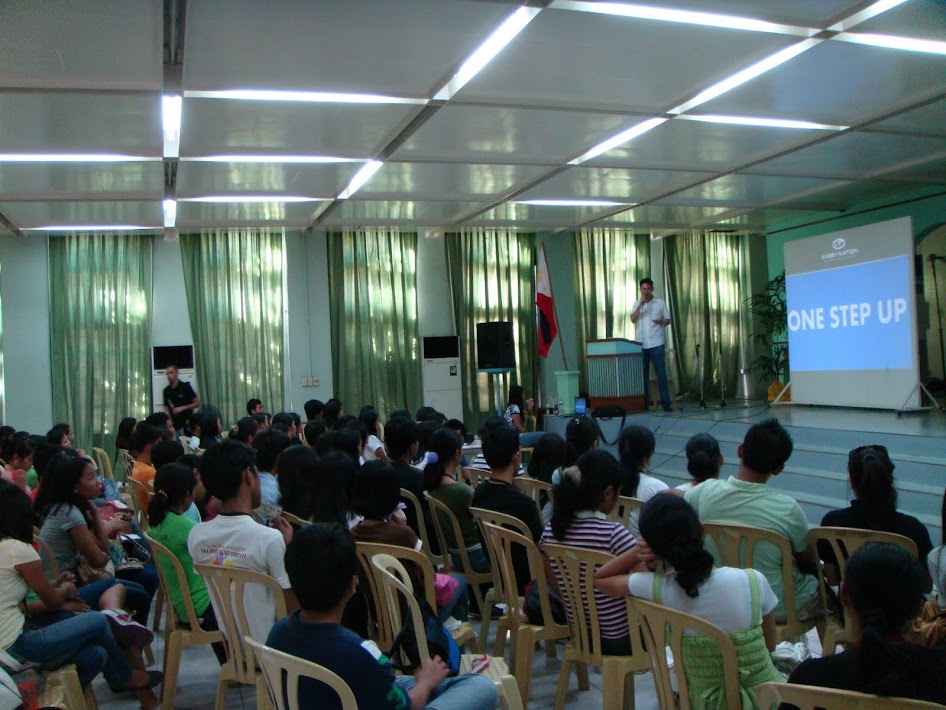
One positive result of my writing is that it has allowed me to interact with the youth, especially students. I have been invited to speak before different schools and groups on encouraging entrepreneurship. This interaction has allowed me to encourage them to form a group, STEP UP (Student Entrepreneurship Provides Unlimited Possibilities), and a few months later, the group was able to hold its first entrepreneurship summit at the University of the Philippines, attended by students of six universities. I also want to share the good news that, the young organization, has been chosen as a country champion for the World Entrepreneurship Day happening this year. Congratulations Neil and the rest of the STEP UP volunteers!


Next week, I will be speaking with the members of the Dynamic Teen Company led by Efren Penflorida on studying and seeking ways to encourage entrepreneurship among the underprivileged youth. I am really thankful for the invitation and opportunity to work with a genuine hero and somebody that I genuinely look up to. It just shows how amazing things can happen from small positive action.


Thank you Jomar for reminding me of what is important. Thank you for allowing me every Friday to exchange and share ideas with you and your students.


Let’s follow the examples of these ordinary individuals as they strive to make a difference. Each week, lets all get together and share knowledge, stories, experiences, information, all for the sole purpose of getting One Step Up.


For comments, suggestions or stories that you want to share, email me at stirspecialist@gmail.com , or visit www.stirspecialist.blogspot.com

I Live in the City of Auda

Have you ever thought of living in the City of Auda? The residents of this city boldly believe everything is possible. In fact, in recent times, one of the more famous citizens was an African American man. This man had the temerity to believe that he could be the forebearer of change and representative of the possibilities of hope in his country. From almost out of nowhere, this man’s message of hope and change captivated his country and propelled him to becoming the leader and symbol of infinite possibilities. Barrack Obama truly showed the world that great things happen if people believe, hope, and contribute to making change become reality.


But he was not the first nor will he be the last. Even among our own people, we have Auda Citizens living amongst us. I want to cite how Manny Paquiao defined the word audacity and shocked the boxing world, showing that a small Filipino can confidently and brashly rewrite boxing history and dominate seven titles and along the way become a living legend and the best pound for pound fighter the boxing world has ever seen.


But I also want to humbly present Efren Penaflorida, who may not have the audacity to believe he could be the hero our country and the world needed to see, but he inspired and moved people to become audacious about the possibilities of large positive change arising from small sincere action.


AUDACITY. It is a big word. It is commonly defined as a supreme boldness to the point of disregarding normal restraint. To me, it means the boldness to dream, to ask , “Why Not?” and to move into action with the vision of disputing the often asked questions of “Why can’t I?”


There is going to be unprecedented presidential debate happening today in Cebu. For the first time, three of our City’s major business chambers have come together to host the debate. There will be six great men who will be quizzed and asked to explain, what is the vision that they are offering in exchange for the chance to become leader of our country. It is a chance for the business community to listen, discern and get to know, who they feel would be able to bring about positive change not only in Cebu, but to our country.


This is of utmost importance. The right selection of not only national leaders but also local ones will be the cornerstone of our country’s progression to the dream that we want to see. We have to discern properly. We have to be able to look beyond empty slogans and promises and see what is important. We have to be able to see the character of these men as well as the principles that they abide by. We also have to look at what motivates these leaders to aspire for the highest position of our country.


But after all is said and done, I also would like to remind others that irregardless of whomever will be chosen and elected, it will be all for naught, if we the people do not believe and participate in the task of nation building.


Real transformational change will not occur if we are not willing to be active agents of it. We cannot expect greatness for our nation if we are not willing to demand it of ourselves. If we truly want our country to be great, we need to be able to demand greatness from our people. It is also important that we bring back responsibility in government, and instill the sense of responsibility back to our people.


I believe this can happen. The country that I dream about, and my children will grow up and live in is slowly happening. But we have to be willing to be part of this process. We can longer stand back and individually prosper, while our country wallows. We have to be willing to commit to whomever we have chosen that we will hold them to their promises, that we will expect them to be responsible and most importantly , we will be there to contribute to make it happen.


I have filed my residency in the City of Auda. I hope you will too. For we definitely need a certain amount of audacity to believe that we will soon be the great nation and people that we always believe we can become.

A Leader's Seven Deadly Sins

The search for the right leader is one of the most crucial crossroads for many companies, corporations, organization and even countries. The right leadership that can inspire, manage, and lead will often usher in a period of success.


The late Peter Drucker was a leading management consultant who wrote several books on management and leadership. He has written 40 books as well as hundreds of articles that are still continuously read and studied to this day. He is recognized as “The father of modern management”. In celebration of his 100th year birthday, a former student and author, William Cohen, wrote a book entitled “Drucker on Leadership”, which compiles many of the latter’s thoughts on leadership.


Peter Drucker believed that leadership was a calling, and that having a moral and ethical center was crucial to being a good leader. He often wrote about character traps that would lead to the demise and failure of leaders, leading to selfishness and abuse of power. William Cohen characterized these traps into the seven deadly sins of leadership, which Drucker sought to emphasize in order to prevent leaders from falling into them. The seven deadly sins of leaders were:


Pride – When a leader believes that rules no longer apply to him, he believes that due to his importance, he can be exempt from normal standards of accountability.


Lust. – Power attracts many things leading to a lot of temptation. A leader’s lack of a moral center often leads to indulgence, which then clouds his ability to render the correct judgment.


Greed. -The sin of greed is a sin of excess. It frequently starts with power. Leaders have power, and power has a tendency to corrupt.


Sloth. –Characterized as an unwillingness to act. It is sometimes seen as a sense of entitlement wherein the leader refuses to do anything he considers to be beneath his position.


Wrath. – The inability to deal with power often leads to anger and wrath as a natural response when things do not happen a leader’s way. The Leader will tend to explode and respond without analyzing properly the situation.


Envy – The belief that every thing should revolve around the leader and when there are things that do not, the natural response is to “attempt to destroy another’s reputation, or in other ways attempt to feel better by lowering the status of another.”


Gluttony - Applies to excessive consumption of any kind. Expects the perks of the position to be a natural reward for it


I believe that in selecting leaders, we have to be recognizant of their natural tendencies to fall into these traps. Or that Leaders, in their quest for position or appointment should themselves introspect and reflect on these sins and how to avoid falling into them.


I think Peter Drucker also was very vocal about writing about these seven sins in order for us to recognize and help the leader avoid them. Leadership in this new decade is no longer about the super CEO or infallible leader. The age of information and communication has empowered even the simplest and lowest member the ability to be informed, comprehend, and in their own ways, respond. Lets look at potential leaders in the right light, not only in terms of accomplishments and capabilities but also for natural tendencies to fall into the seven deadly sins.


I really like this quote, "Leadership is first and foremost about character, one who is in power but not subordinate to it, one who has control of money but is not lured by it, one whose position opens all doors but prefers the simplicity of lifestyle , and one who is followed"


Let’s follow the examples of these ordinary individuals as they strive to make a difference. Each week, lets all get together and share knowledge, stories, experiences, information, all for the sole purpose of getting One Step Up.


For comments, suggestions or stories that you want to share, email me at stirspecialist@gmail.com , or visit www.stirspecialist.blogspot.com

The Fifteen Minute Advantage

A lot of people reacted strongly to what I wrote about the square watermelon. Majority of them liked the idea of innovation, but questioned how can it really be achieved, and if the inherent risks of failure is worth the effort. In today’s uncertain economic climate, some asked, is it really the right time to be innovating and how does one start?


Everybody loves successful innovations but not many want to be the one starting them. So what can we do? Rosabeth Kanter, a professor at the Harvard business school, wrote something revealing on starting innovation. She wrote a article on the "15 minute competitive advantage" which she said can be used to break innovation down to a manageable level, she wrote that change should happen , “in short fast bursts rather than waiting for the breakthrough that transforms everything. If every proverbial 15 minutes, you learn something and incorporate it into the next speedy step, you'll continue to be ahead. And a few time periods later, transformation will be underway.”


Professor Kantor is a firm believer that instead of changing the whole system, it should be changed just enough at a time but also continuously adapting and innovating. This will allow the company to listen and adapt to the market needs rather than force the latter to accept a whole new line of thought.


She emphasized, “Stay a little ahead of the competition while close enough to what customers can understand and incorporate, and the innovation idea is easier to sell” It actually makes so much sense.


Many instances will show us that even though the innovation made all the sense in the world, if we introduce it too rapidly or radically, it will cause the market to instinctively reject it. But by introducing it in short systematic bursts, it will allow the market to absorb it unconsciously.


The other point the Professor made is that the innovation should have certain characteristics in order to make it easier to accept and support, it should be:

1.

Trial-able: The idea or product can be demonstrated on a pilot basis. Customers can see it in action first and incorporate it on a small scale before committing to replace everything.


2. Divisible: It can be adopted in segments or phases. Users can ease into it, a step at a time. They can even use it in parallel with current solutions.


3. Reversible: If it doesn't work, it's possible to return to pre-innovation status. Eventually you want life to be unimaginable without it, but at least in theory, it's possible to go back to zero.


4. Tangible: It offers concrete results that can be seen to make a difference in something that users need and value.


5. Fits prior investments: The idea builds on "sunk costs" or actions already taken, so it looks like not much change is involved.


6. Familiar: It feels like things that people already understand, so it is not jarring to use. It is consistent with other experiences, especially successful ones.


7. Congruent with future direction: It is in line with where things are heading anyway. It doesn't require people to rethink their priorities or pathways, even though of course it changes things.


8. Positive publicity value: It will make everyone look good.


Do you agree? Her points do allow innovation to be thought of in a rational and realistic manner. So what are we waiting for? Let’s start looking for our own square watermelons, and take the first few steps into the innovation decade.


Let’s follow the examples of these ordinary individuals as they strive to make a difference. Each week, lets all get together and share knowledge, stories, experiences, information, all for the sole purpose of getting One Step Up.


For comments, suggestions or stories that you want to share, email me at stirspecialist@gmail.com , or visit www.stirspecialist.com